
Advocacy Starts With Clarity, Not Volume
Advocating for your child at school can feel intimidating, especially when the stakes are high and the systems aren’t always easy to navigate. Many parents walk into meetings unsure of what to ask for, how to frame their concerns, or whether they’ll be taken seriously. But effective advocacy isn’t about being the loudest voice in the room, it’s about being clear, consistent, and grounded in evidence.
From a behavioral perspective, advocacy becomes far more straightforward. The goal is not simply to stop challenging behavior or push for vague “support,” but to identify what your child needs to succeed and ensure those supports are implemented in a consistent, measurable way. When you shift from reacting to behavior to understanding it, your role in the conversation changes–and so do the outcomes.
Understand the Function Behind the Behavior
One of the most important places to start is by understanding the “why” behind your child’s behavior. In Applied Behavior Analysis (ABA), behavior is viewed as functional, meaning it serves a purpose. A child might be trying to gain attention, avoid a task that feels overwhelming, access something they want, or respond to sensory input in their environment. When you can identify that underlying function, your advocacy becomes more precise and harder to dismiss.
Instead of simply describing what your child is doing, you’re explaining why it’s happening and what kind of support would address it. That shift is often what moves conversations from vague concern to actionable planning.
Let Data Strengthen Your Voice
This is where data becomes a powerful tool. While it’s natural to feel emotional when your child is struggling, schools are often most responsive to objective, observable information. Even simple tracking over a week or two can reveal meaningful patterns. Noticing when a behavior occurs, what tends to happen right before it, and how adults respond afterward can help paint a clearer picture of what’s driving the issue.
When you’re able to point to consistent patterns, such as a behavior emerging during independent work after a few minutes without support, you’re no longer raising a general concern. You’re presenting a specific problem that can be solved, which makes it much easier for a school team to respond effectively.
Use Formal Supports to Your Advantage
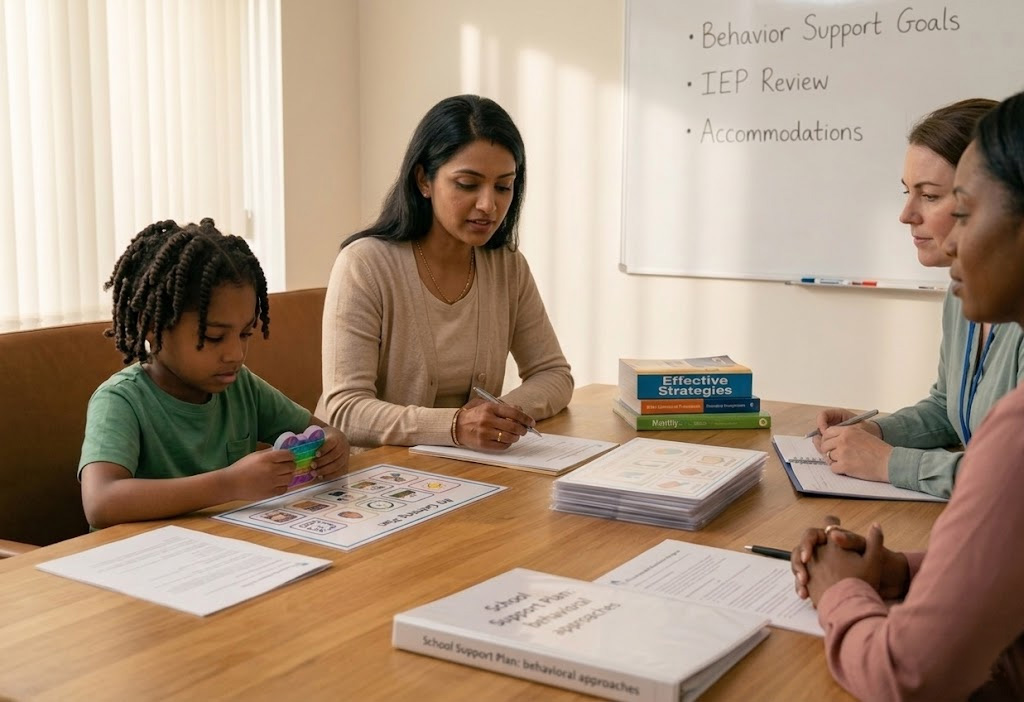
At the same time, it’s important to understand the formal structures that exist to support your child. Many families request either an Individualized Education Program (IEP) or a Section 504 Plan, both of which are designed to ensure students receive the accommodations or specialized instruction they need.
These plans are not informal agreements; they are legally binding documents. That distinction matters, because it means the supports written into them are not optional. When you advocate within this framework, you shift the conversation from preference to obligation, which often leads to more consistent follow-through.
Collaborate on Teaching Skills, Not Just Stopping Behavior
A common mistake in school-based advocacy is focusing only on stopping behavior. From a behavioral standpoint, that approach tends to fall short because it doesn’t address the reason the behavior is happening in the first place.
More effective advocacy centers on function-based interventions, which aim to teach new skills and adjust the environment so the behavior is less likely to occur. This might mean helping a child learn how to appropriately request a break instead of leaving their seat, or modifying the difficulty of a task so it no longer triggers avoidance. Approaches like Positive Behavior Support emphasize this shift, focusing on prevention, skill-building, and consistent reinforcement rather than punishment.
Define What Success Actually Looks Like
Clarity is another critical piece of the puzzle. Vague language in school plans often leads to inconsistent implementation, which in turn leads to limited progress. When supports are discussed, it’s worth pressing for specifics: what exactly will happen, when it will happen, and how success will be measured.
The difference between a loosely defined support and a clearly articulated, repeatable strategy is often the difference between a plan that exists on paper and one that actually changes a child’s daily experience. Specificity creates accountability, and accountability drives results.
Collaborate Without Stepping Back
Effective advocacy requires a balance between collaboration and confidence. Teachers and school staff bring important expertise, but parents bring something equally valuable: a deep, nuanced understanding of their child.
The most productive conversations tend to stay focused on problem-solving rather than blame, while still holding firm to the goal of meeting the child’s needs. If a strategy isn’t working, it’s both reasonable and necessary to say so, and to ask for adjustments based on what the data is showing. Advocacy works best when it’s collaborative, but it still needs to be directed.
Consistency Is What Makes Advocacy Work
It’s important to recognize that advocacy is not a one-time event. Behavioral change depends on consistency, and so does the implementation of supports. Following up after meetings, requesting documentation of agreed-upon plans, and continuing to share observations from home all help ensure that interventions are carried out as intended.
Without that ongoing attention, even well-designed supports can fade over time. Staying engaged helps keep the plan active, relevant, and responsive to your child’s needs as they evolve.
The Long-Term Impact of Behavioral Advocacy
Advocating for your child may never feel effortless, but it does become more manageable. When you ground your approach in behavioral principles—understanding function, using data, and focusing on teachable skills—you move from a place of uncertainty to one of strategy.
And in that shift, advocacy becomes not just about getting through the next school meeting, but about building a system that truly supports your child’s growth both inside and outside the classroom.
Frequently Asked Questions
How do I start advocating for my child at school if I feel overwhelmed?
The most effective place to start is by focusing on observation rather than action. Begin by noticing patterns in your child’s behavior: when it happens, what happens right before it, and what tends to follow. You don’t need perfect data, but having a clear description of patterns will make conversations with the school more productive. From there, request a meeting with your child’s team and focus on sharing what you’re seeing rather than immediately proposing solutions.
What is the most effective way to communicate concerns to a teacher or school team?
Clear, specific, and behavior-focused communication tends to be most effective. Instead of general statements like “my child is struggling,” it helps to describe what the behavior looks like, when it occurs, and how often it happens. Framing concerns around observable patterns makes it easier for school teams to identify function-based supports and respond with actionable interventions.
What is a function-based approach to behavior?
A function-based approach comes from Applied Behavior Analysis and focuses on understanding why a behavior is happening rather than just trying to stop it. Most behavior serves a function such as gaining attention, avoiding a difficult task, accessing something preferred, or responding to sensory needs. Once the function is identified, interventions can be designed to teach alternative skills and reduce the need for the behavior itself.
What’s the difference between an IEP and a 504 plan?
An Individualized Education Program provides specialized instruction and services for students who qualify under specific disability categories, while a Section 504 Plan provides accommodations to ensure equal access to learning for students who do not require specialized instruction. Both are legally binding and can include behavioral supports when needed.
What if the school says they “don’t see the behavior”?
This is a common challenge in advocacy. It can help to document patterns over time, including when behaviors occur, how frequently they happen, and any triggers you notice. Sharing consistent data helps shift the conversation from perception (“we don’t see it”) to pattern recognition (“this is when and how it occurs”). You can also request formal observation or assessment through the school team if concerns persist.
What are function-based interventions in schools?
Function-based interventions are strategies designed to address the underlying reason for a behavior rather than just the behavior itself. For example, if a child is avoiding difficult work, an intervention might involve breaking tasks into smaller steps or teaching them how to request help appropriately. These approaches are often part of Positive Behavior Support, which emphasizes skill-building and environmental adjustments.
How long does it take to see progress once supports are in place?
Timelines vary depending on the child and the consistency of implementation. In many cases, early signs of progress can be seen within a few weeks if strategies are applied consistently across settings. However, meaningful behavioral change often requires ongoing adjustment, data review, and collaboration between parents and school staff over time.